
For die builders, mold makers and maintenance engineers, bushing failure is more than a minor inconvenience — it causes misalignment, scrapped parts, unexpected downtime and repeated replacement costs that eat into production profitability.
Most standard bronze bushings on the market rely on simple surface coating or sintered layers. Under continuous heavy load, high vibration and millions of cycles, these layers delaminate, wear unevenly and lose dimensional accuracy quickly.
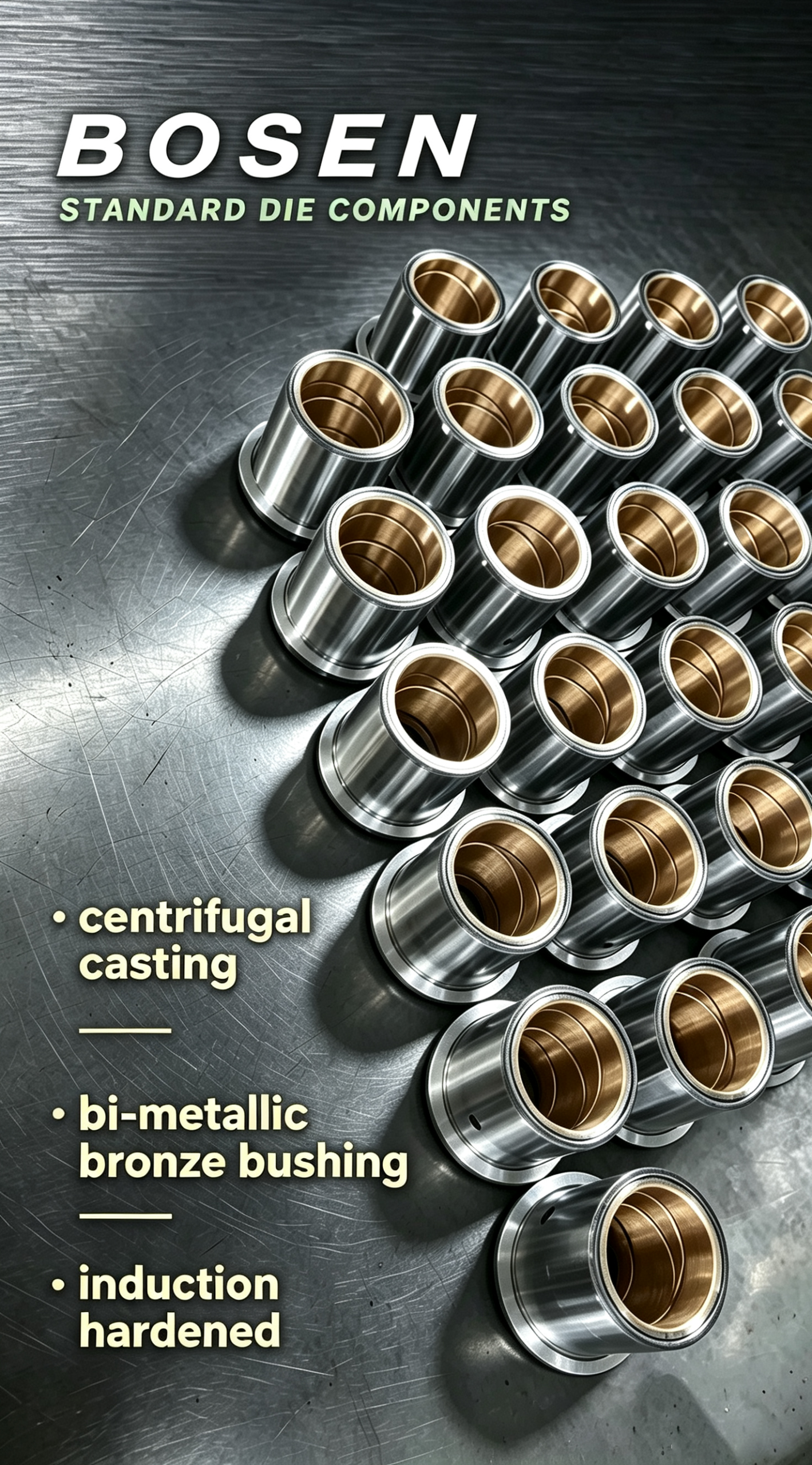
The solution lies in two advanced manufacturing processes: centrifugal casting and induction hardening. Combined in a bi-metallic bronze-steel design, they create a bushing built for extreme durability and long-term precision.
The Real Cost of Premature Bushing Wear
Before diving into the solution, consider what a failed bushing actually costs:
- Unplanned downtime: A single stamping line can cost thousands of dollars per hour when it stops.
- Scrapped parts: Misaligned dies from worn bushings produce out-of-tolerance components that hit the scrap bin.
- Labor and maintenance hours: Frequent changeouts take skilled maintenance technicians away from higher-value work.
- Inventory carrying costs: Keeping spare bushings on hand ties up working capital.
Cheap bushings look good on a purchase order. On the production floor, they cost far more.
Why Standard Bronze Bushings Fail Early
Conventional bushings fall short in heavy-duty stamping and mold applications for four structural reasons:
- Porosity in cast bronze: Traditional gravity casting leaves internal voids that become weak points under load.
- Weak bonding between layers: Pressed or glued bronze liners can delaminate under radial stress.
- Surface-only hardness: Without controlled hardening, the working surface softens and ovalizes over time.
- Inconsistent tolerances: Lower-grade machining fails to hold tight tolerances through thermal cycles.
The result: more frequent changeouts, more maintenance, and higher long-term costs — even when the upfront price looks attractive.
How Centrifugal Casting Solves the Core Problem
At BOSEN, our bi-metallic bronze bushings are manufactured using centrifugal casting technology, which fundamentally changes the structure and performance of the bronze lining.
The Process
Molten bronze is poured onto the inner wall of a rotating steel backing. Centrifugal force presses the metal uniformly against the steel surface, pushing out impurities and gas bubbles while the material solidifies.
What This Means for Performance
- 100% dense, porosity-free bronze structure — no internal voids, no weak spots, even wear across the entire working surface.
- Metallurgical bond to steel backing — bronze and steel fuse at the molecular level, eliminating delamination risk even under extreme shock loads.
- Uniform bronze thickness — consistent performance along the full length of the bushing, no thin spots or uneven wear.
For high-cycle progressive stamping dies and heavy injection mold bases, this means dramatically longer service life and stable performance from day one.
Induction Hardening: Precision Hardness That Holds
A dense bronze layer is only as good as the structural integrity behind it. That’s why every BOSEN bi-metallic bushing goes through controlled induction hardening on critical working surfaces.
Induction hardening uses high-frequency electromagnetic energy to heat the material precisely to the required depth, then quenches it rapidly. This creates a hard, wear-resistant surface while retaining a tough, impact-resistant core.
Key benefits:
- Controlled effective hardening depth — optimized for wear resistance without brittleness.
- Consistent hardness across the full bore — no soft spots, no uneven inner wear.
- Maintains tight tolerances under thermal stress — resists deformation from friction heat in high-speed operations.
- Excellent surface finish — reduces friction and protects mating components.
The result is a bushing that holds tight tolerance grades far longer than standard alternatives, keeping your dies aligned and your parts consistent.
Where BOSEN Bushings Deliver the Most Value
Our centrifugal cast bi-metallic bronze bushings are engineered for heavy-load, high-cycle environments where reliability directly impacts the bottom line:
- Progressive stamping dies and blanking dies
- Plastic injection mold bases and die casting molds
- Automation equipment and industrial machinery
- Heavy-duty machine tools and press lines
- Maintenance, repair and operations (MRO) for manufacturing plants
Standard Stock + Full Custom Capability
We understand that production teams need both speed for urgent maintenance and flexibility for custom tooling projects.
ISO / DIN Standard Stock
Standard sizes of bi-metallic bronze bushings, bearing bushes and flanged bushes are kept in stock for immediate shipment — meaning fast turnaround for emergency breakdowns, short lead times for standard die builds, and reliable supply for recurring orders.
Custom Manufacturing to Your Drawings
No two tooling projects are identical. We produce fully custom bushings strictly to your engineering drawings, including:
- Custom diameters, lengths and wall thicknesses
- Flanged designs and special mounting features
- Custom oil groove patterns and lubrication holes
- Alternative bronze alloys and steel backing materials
- Special tolerance requirements for unique applications
Final Thought
Cheap bushings cost far more than their price tag suggests. Every hour of unplanned downtime, every scrapped batch, every maintenance call adds up.
Investing in high-quality centrifugal cast bi-metallic bronze bushings isn’t just buying a better component — it’s lowering your total cost of ownership, improving part quality, and protecting the uptime of your most critical equipment.
Ready to Upgrade Your Bushing Performance?
- Browse our standard bi-metallic bushing catalog → https://www.bosen-group.com/products/bi-metallic-bronze-steel-bushes-manufacturer-bosen
- Request a custom quote with your drawings → https://www.bosen-group.com/why-bosen
- Explore all BOSEN die components → https://www.bosen-group.com/products/products