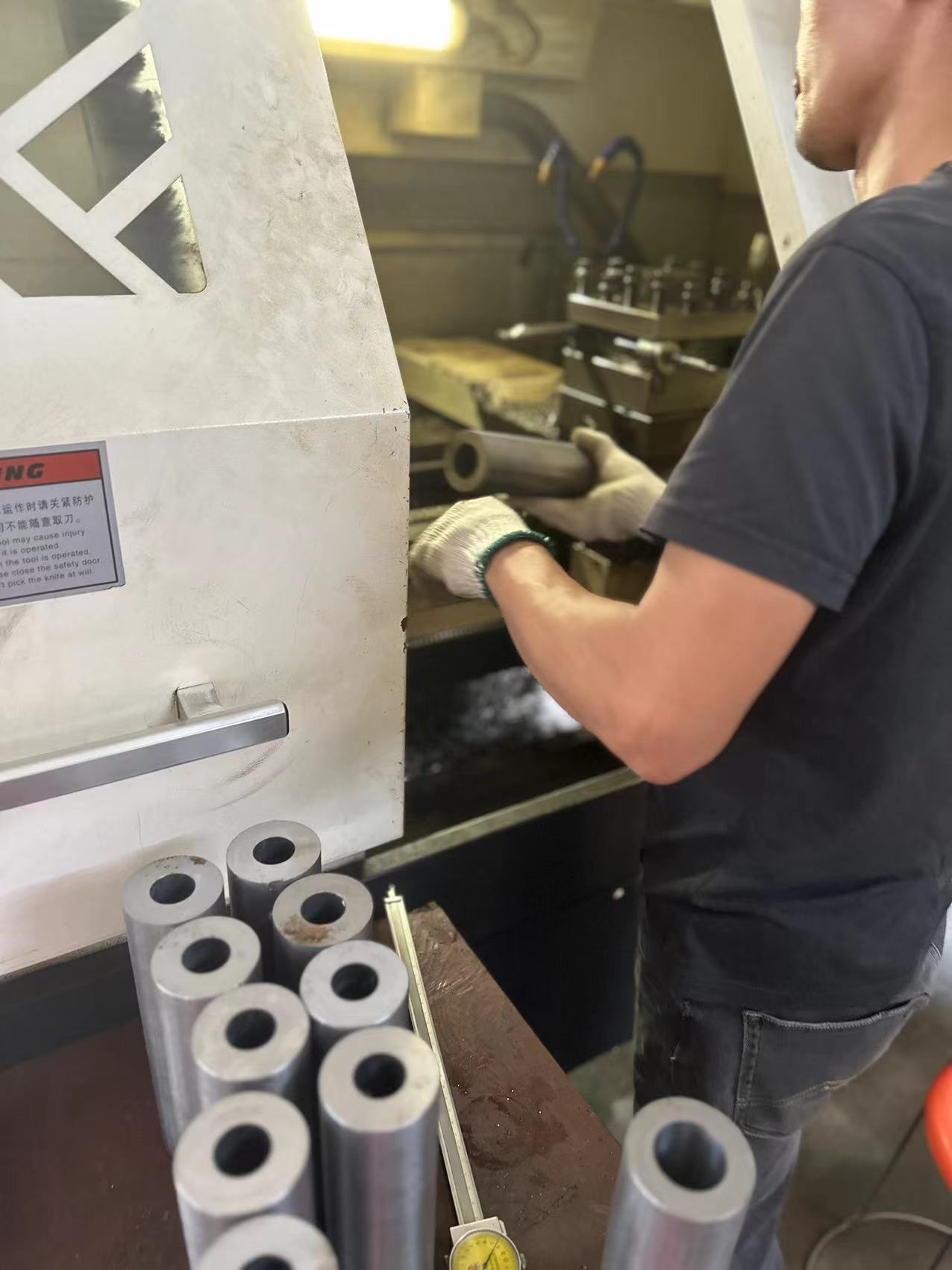
For die builders, mold makers and maintenance engineers, bushing failure is more than a minor inconvenience — it causes misalignment, scrapped parts, unexpected downtime and repeated replacement costs that eat into production profitability.
Most standard bronze bushings on the market rely on simple surface coating or sintered layers. Under continuous heavy load, high vibration and millions of cycles, these layers delaminate, wear unevenly and lose dimensional accuracy quickly.
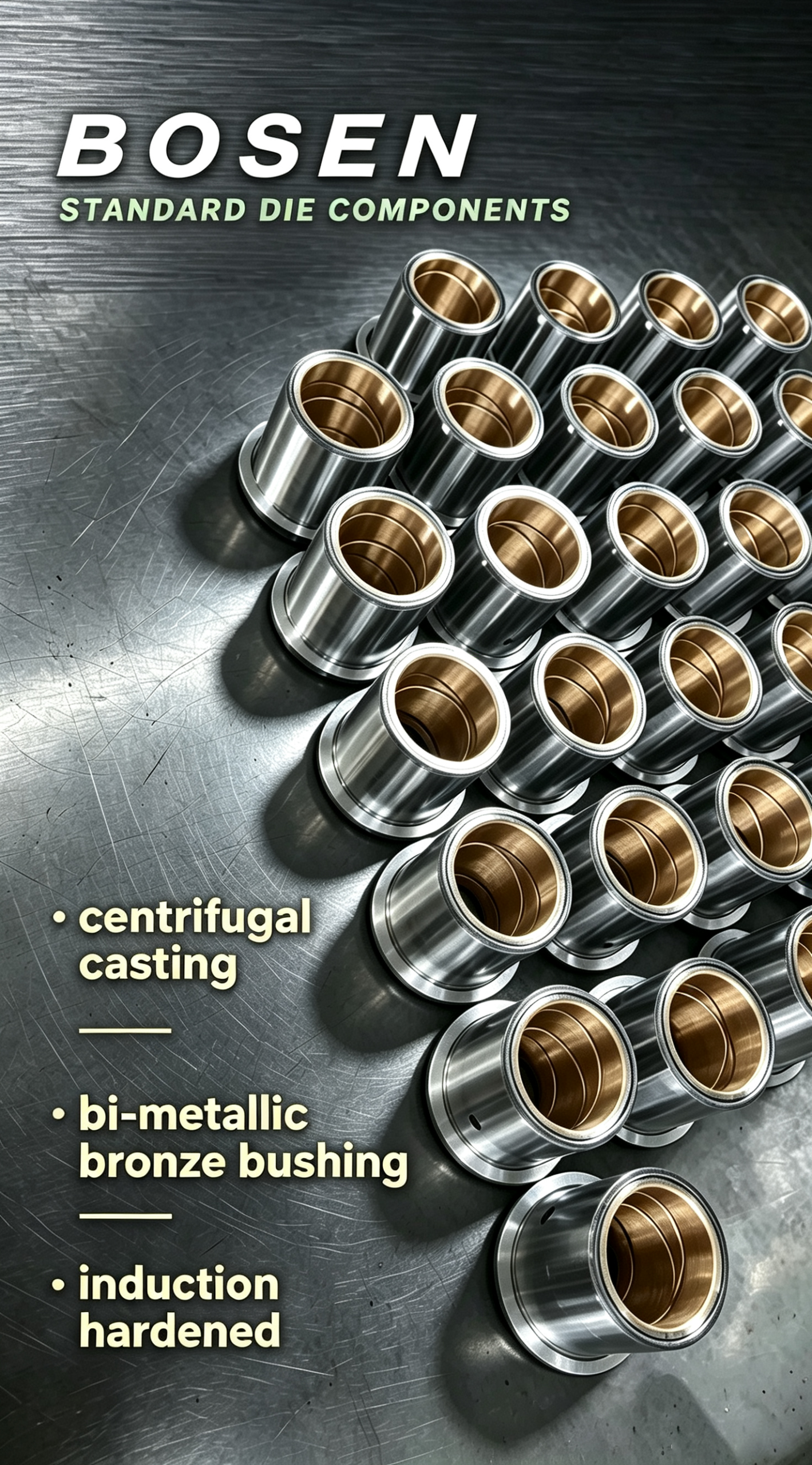
The solution lies in two advanced manufacturing processes: centrifugal casting and induction hardening. Combined in a bi-metallic bronze-steel design, they create a bushing built for extreme durability and long-term precision.
The Real Cost of Premature Bushing Wear
Before diving into the solution, consider what a failed bushing actually costs:
Unplanned downtime: A single stamping line can cost thousands of dollars per hour when it stops.
Scrapped parts: Misaligned dies from worn bushings produce out-of-tolerance components that hit the scrap bin.
Labor and maintenance hours: Frequent changeouts take skilled maintenance technicians away from higher-value work.
Inventory carrying costs: Keeping spare bushings on hand ties up working capital.
Cheap bushings look good on a purchase order. On the production floor, they cost far more.
Why Standard Bronze Bushings Fail Early
Conventional bushings fall short in heavy-duty stamping and mold applications for four structural reasons:
Porosity in cast bronze: Traditional gravity casting leaves internal voids that become weak points under load.
Weak bonding between layers: Pressed or glued bronze liners can delaminate under radial stress.
Surface-only hardness: Without controlled hardening, the working surface softens and ovalizes over time.
Inconsistent tolerances: Lower-grade machining fails to hold tight tolerances through thermal cycles.
The result: more frequent changeouts, more maintenance, and higher long-term costs — even when the upfront price looks attractive.
How Centrifugal Casting Solves the Core Problem
At BOSEN, our bi-metallic bronze bushings are manufactured using centrifugal casting technology, which fundamentally changes the structure and performance of the bronze lining.
The Process
Molten bronze is poured onto the inner wall of a rotating steel backing. Centrifugal force presses the metal uniformly against the steel surface, pushing out impurities and gas bubbles while the material solidifies.
What This Means for Performance
100% dense, porosity-free bronze structure — no internal voids, no weak spots, even wear across the entire working surface.
Metallurgical bond to steel backing — bronze and steel fuse at the molecular level, eliminating delamination risk even under extreme shock loads.
Uniform bronze thickness — consistent performance along the full length of the bushing, no thin spots or uneven wear.
For high-cycle progressive stamping dies and heavy injection mold bases, this means dramatically longer service life and stable performance from day one.
Induction Hardening: Precision Hardness That Holds
A dense bronze layer is only as good as the structural integrity behind it. That’s why every BOSEN bi-metallic bushing goes through controlled induction hardening on critical working surfaces.
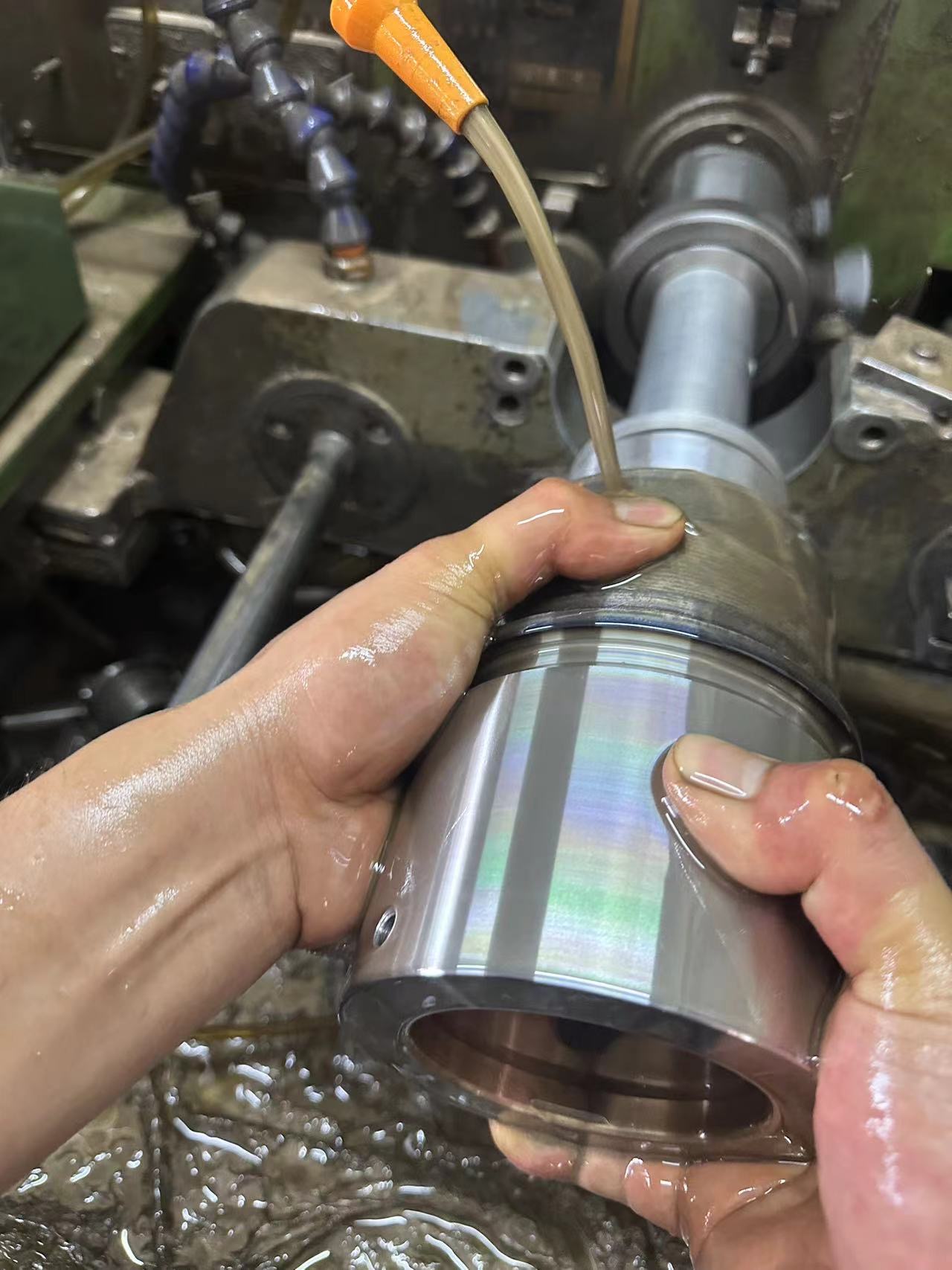
Induction hardening uses high-frequency electromagnetic energy to heat the material precisely to the required depth, then quenches it rapidly. This creates a hard, wear-resistant surface while retaining a tough, impact-resistant core.
Key benefits:
Controlled effective hardening depth — optimized for wear resistance without brittleness.
Consistent hardness across the full bore — no soft spots, no uneven inner wear.
Maintains tight tolerances under thermal stress — resists deformation from friction heat in high-speed operations.
Excellent surface finish — reduces friction and protects mating components.
The result is a bushing that holds tight tolerance grades far longer than standard alternatives, keeping your dies aligned and your parts consistent.
Where BOSEN Bushings Deliver the Most Value
Our centrifugal cast bi-metallic bronze bushings are engineered for heavy-load, high-cycle environments where reliability directly impacts the bottom line:
Progressive stamping dies and blanking dies
Plastic injection mold bases and die casting molds
Automation equipment and industrial machinery
Heavy-duty machine tools and press lines
Maintenance, repair and operations (MRO) for manufacturing plants
Standard Stock + Full Custom Capability
We understand that production teams need both speed for urgent maintenance and flexibility for custom tooling projects.
ISO / DIN Standard Stock
Standard sizes of bi-metallic bronze bushings, bearing bushes and flanged bushes are kept in stock for immediate shipment — meaning fast turnaround for emergency breakdowns, short lead times for standard die builds, and reliable supply for recurring orders.
Custom Manufacturing to Your Drawings
No two tooling projects are identical. We produce fully custom bushings strictly to your engineering drawings, including:
Custom diameters, lengths and wall thicknesses
Flanged designs and special mounting features
Custom oil groove patterns and lubrication holes
Alternative bronze alloys and steel backing materials
Special tolerance requirements for unique applications
Final Thought
Cheap bushings cost far more than their price tag suggests. Every hour of unplanned downtime, every scrapped batch, every maintenance call adds up.
Investing in high-quality centrifugal cast bi-metallic bronze bushings isn’t just buying a better component — it’s lowering your total cost of ownership, improving part quality, and protecting the uptime of your most critical equipment.
Choosing the right guiding elements for a stamping or die-casting die is a fundamental decision that affects tool life, maintenance frequency, and overall production efficiency. Two standard options dominate the market: bronze-plated guide bushes (sliding guides) and ball cages (rolling guides) . Both serve the same purpose — guiding the relative motion between the punch holder and the die holder — but they operate on different principles and suit different operating conditions.
This article provides a technical comparison between the two, explains where each excels, and offers practical guidance for sourcing and inventory management.
1. Operating Principle and Constructio
.
Bronze-Plated Guide Bush (Sliding Guide)
Ball Cage (Rolling Guide)
Principle
Sliding friction — metal-on-metal with lubrication
Rolling friction — steel balls recirculate within a cage between the pillar and the bushing
Construction
Steel bushing with centrifugally cast bronze layer; oil grooves on the inner surface
Steel bushing and pillar, with a cage (aluminum, POM, or copper alloy) and precision steel balls between them
Lubrication
Circumferential oil grooves; relies on lubricant film for separation
Minimal lubrication required; grease retained in the cage
Clearance
Clearance fit (typically ~0.01mm), suitable for die clearances >0.03mm
Preloaded — near-zero clearance; reduces radial play and improves alignment precision
2. Performance Comparison: Speed, Load, and Wear
2.1 Speed Range
Sliding guides: Recommended for operating speeds up to 45 m/min. Higher speeds can lead to breakdown of the lubricant film, increasing friction and wear.
Rolling guides: Suitable for high-speed applications above 45 m/min. The rolling elements generate minimal friction regardless of speed — the coefficient of friction can be as low as 0.001.
2.2 Load Capacity and Wear Patterns
Sliding guides: The contact area distributes load over a larger surface. This makes them well-suited for thick materials, high shear forces, and short-stroke applications. Wear occurs gradually on the bronze layer, which is serviceable.
Rolling guides: The balls concentrate the load at discrete contact points, enabling near-zero clearance and high rigidity. However, the ball cage itself is the most vulnerable component — cage failure (e.g., aluminum cage deformation at high speed, POM cage creep under sustained load) can cause sudden loss of precision.
2.3 Service Life Considerations
For a die operating at 20–30 m/min with moderate loads (the most common stamping application range):
A properly lubricated bronze-plated sliding guide can deliver consistent performance for 1–2 years with regular maintenance.
A ball cage may provide higher precision but is more sensitive to contamination and lubrication degradation. Cage material selection is critical — POM cages are lighter but have lower load capacity; aluminum cages have higher load capacity but may generate particles at high speeds.
3. Economic and Supply Chain Implications
For distributors, brand owners, and inventory managers, the technical difference is only half the story. The other half is how each option affects stocking strategy and after-sales support.
Factor
Sliding Guide (Bronze-Plated)
Rolling Guide (Ball Cage)
Replacement complexity
Simple — any guide pillar of the correct diameter can be used. No matched pairing required
Complex — pillar, bushing, and cage must be matched and paired. Replacing one component without the other may introduce play or binding
Inventory flexibility
Easy to stock — fewer variations, interchangeable across brands
Inventory-heavy — each size requires multiple matched components
Customer support
Lower support cost — straightforward troubleshooting
Higher support cost — cage selection, ball wear, and cage material all affect performance
Cost (typical)
Lower procurement cost
Higher procurement cost due to precision assembly
4. Decision Matrix: Which One Should You Use?
This matrix reflects both technical suitability and supply chain practicality:
Application Scenario
Recommended Guide Type
Reasoning
High-speed stamping (>45 m/min)
Ball Cage
Rolling friction withstands high speeds; near-zero clearance ensures consistent alignment at speed
Either — but bronze-plated is often more cost-effective
Both work technically; bronze-plated offers simpler stocking and lower cost
Distributor / stockist inventory
Bronze-Plated Sliding Guide
Simpler to stock; easier to support; fewer components to manage
5. BOSEN’s Manufacturing Capability
BOSEN manufactures both types of guiding elements to ISO 9182 and DIN standards:
Bronze-Plated Guide Bushes (Sliding)
Steel base with centrifugally cast bronze layer
Inner diameter precision ground to tolerances within 0.01mm
Circumferential oil groove design for consistent lubrication
Suitable for 0–45 m/min speed range
Guide Pillars
Surface hardened to 60+2 HRC, case depth ≥1.8mm
Precision ground for direct fit with both sliding and rolling guides
Ball Cages (Rolling)
Available in aluminum, POM, or copper alloy
Steel balls graded to within 0.0025mm consistency
Preloaded assembly provides near-zero clearance
All products are manufactured in-house — heat treatment, grinding, and inspection are completed within the factory, ensuring full traceability and quality control.
6. Frequently Asked Questions
Q: Can a bronze-plated guide bush be used with any guide pillar? A: Yes. Unlike ball cages, bronze-plated sliding guides do not require matched pairing. Any guide pillar with the correct diameter and surface hardness will work.
Q: What causes premature wear in bronze-plated bushes? A: Most commonly: insufficient lubrication, contamination (metal chips or grit), or operating beyond the recommended speed range (above 45 m/min).
Q: How do I know if a ball cage needs replacement? A: Listen for unusual noise during die operation. Inspect for cage deformation, missing balls, or visible wear on the ball tracks.
7. Summary
Bronze-Plated Sliding Guide
Ball Cage Rolling Guide
Best for
Thick materials, high shear, short strokes, moderate speed
High-speed stamping, high precision, long stroke
Speed range
0 – 45 m/min
>45 m/min
Friction
Higher (with lubrication)
Lower
Inventory
Simple to stock
Requires matched pairs
Cost
Lower
Higher
For most general stamping applications and for distributors managing inventory for a broad customer base, the bronze-plated sliding guide is the more practical and cost-effective choice. For high-speed, high-precision applications, the ball cage offers superior performance but requires more careful specification and support.
Quick Inquiry
If you’re sourcing guide elements for stamping or die-casting tools, send us your drawing or part number. We’ll respond with a quote and lead time within 24 hours.
BOSEN – Standard Die Components, Guiding Elements for Stamping & Die-Casting Tools
In the precision manufacturing world, terminology matters. While “Die” and “Mould” are sometimes used interchangeably, they represent two fundamentally different processes. At BOSEN, we have tailored our expertise to help you navigate these differences and optimize your supply chain.
Let’s break down how we support your manufacturing needs:
⚙️ Standard Die Components: Our Core Manufacturing Expertise
Standard Die Components are designed for stamping, pressing, and die-casting processes. These tools shape metals through immense mechanical force and high-speed impacts.
At BOSEN, this is where our true manufacturing power lies. We specialize in the in-house precision machining of heavy-duty die components, including guide posts/pillars, stripper plates, punches, and die blocks. Engineered to withstand severe lateral thrusts and shock loads, our die components ensure zero-defect precision under high-speed press operations.
🧩 Standard Mould Components: Streamlining Your Supply Chain
Standard Mould Components are the backbone of plastic injection molding, focusing on smooth sliding friction, thermal stability, and precise alignment.
While our core machining expertise is in die components, we understand that modern manufacturers often prefer to consolidate their supply chain for better efficiency. For clients requiring standard mould components (such as guide pins/bushes, ejector pins, and mould bases), BOSEN acts as your strategic resource partner. We integrate high-quality mould components into your existing orders, allowing you to centralize procurement, reduce vendor management overhead, and achieve true cost efficiency.
🔍 Why Consolidate with BOSEN?
Whether you need our precision-machined die parts or our sourced mould accessories, working with BOSEN offers massive advantages:
Single Point of Contact: Simplify your procurement process and save time.
Cost Efficiency: Reduce logistics and administrative costs by centralizing your tooling supply.
Quality Assurance: Whether manufactured in-house or sourced, all components meet strict quality standards.
🤝 Partner with BOSEN for Your Tooling Needs
Navigating the differences between die and mould components shouldn’t slow down your production. At BOSEN, we are your dedicated partner for Standard Die Components manufacturing and your strategic resource for Standard Mould Components.
💡 Ready to consolidate your tooling supply chain and optimize your manufacturing? Explore our precision die components or contact our team today to discuss how we can streamline your mould component sourcing. Let’s build something precise and efficient together!
Centrifugal casting is a specialised metal manufacturing process whereby molten metal is poured into a rapidly rotating mould. Centrifugal force shapes dense, high-quality components with predictable structure and integrity.
The centrifugal casting process pushes molten metal towards the mould walls, enabling directional solidification and impurity control. This is crucial for automotive applications demanding tight tolerances and high reliability.
BOSEN’s steel-bronze bushings, manufactured via centrifugal casting, differ fundamentally from those produced by conventional press-fit methods. This bronze is not only thicker but is bonded through a dual fusion casting process. Consequently, these bronze-lined bushings will not ‘chip out’ or crack like plated bushings. Indeed, if you drill a hole through our bushings, the steel and bronze will remain inseparable, not even on the chips!
Advantages of Centrifugal Casting Technology –Achieves exceptional casting precision through controlled solidification, reducing porosity and enhancing batch-to-batch consistency. –Eliminates cores and complex pouring systems, simplifying metal fabrication and reducing rework. –Produces defect-free components with superior material integrity, suitable for safety-critical applications. –Achieves uniform wall thickness in hollow components via centrifugal casting. –Scalable contract manufacturing for high-volume requirements while maintaining part traceability. –Combines with advanced investment casting techniques when required to enhance mechanical properties. –Provides an economical alternative to traditional casting and forging processes for cylindrical geometries.
Materials Used in Centrifugal Casting Technology Ferrous Alloys: Cast iron and stainless steel, commonly employed in casting and forging projects. Non-ferrous alloys: Bronze, copper, and aluminium, employed in investment casting and centrifugal processes. Superalloys: Inconel and Hastelloy, meeting high-temperature precision casting requirements. Composite materials: Internal coatings and liners, utilised in conjunction with centrifugal casting under specified conditions. Automotive-grade alloys: Specifically engineered for automotive centrifugal casting, ensuring wear resistance and longevity.
Frequently Asked Questions (FAQ) Q: What is centrifugal casting? A: A metal manufacturing technique utilising centrifugal force to distribute molten metal within a rotating mould, forming dense, defect-resistant cylindrical components with uniform properties.
Q: How does centrifugal casting enhance material quality? A: The process pushes inclusions towards the bore, producing cleaner outer walls and achieving superior casting accuracy with reduced porosity.
Q: Which industries commonly utilise centrifugal casting? A: Automotive, aerospace, oil and gas, marine, power generation, and general contract manufacturing where reliability and geometric repeatability are paramount.
Q: How does centrifugal casting differ from investment casting? A: Investment casting supports extremely complex geometries, whereas centrifugal casting excels at producing cylindrical components with superior strength and dimensional stability.
Q: What is the precision of centrifugal cast components? A: Strict tolerances and uniform wall thickness are achieved by controlling rotational speed, temperature, and moulds, confirmed through dimensional inspection.
Q: Is centrifugal casting economical? A: For hollow components, it is typically more cost-effective than forging or heavy machining, especially with stable production batches.
Q: How is centrifugal casting quality assured? A: We implement rigorous inspection, perform non-destructive testing where necessary, and conduct dimensional checks post-centrifugal casting to ensure full process traceability.
Q: What automotive applications utilise centrifugal casting? A: Engine sleeves, bushings, rings, and other high-stress cylindrical components requiring wear resistance and casting precision.
Q: What are the maximum estimated transit times from our factory to global regions (sea and air freight)? Sea freight: Asia: 15–20 days, Europe: 25–35 days, North America: 30–40 days, South America: 35–45 days, Middle East: 14–18 days, Africa: 20–28 days, Oceania: 22–30 days Air freight: Asia: 1–3 days, Europe: 3–5 days, North America: 4–6 days, South America: 5–7 days, Middle East: 1–2 days, Africa: 3–5 days, Oceania: 4–6 days
The landscape for mold component sourcing in Europe is undergoing a fundamental recalibration. As we look toward 2026, importers and distributors are navigating a market defined not by volume, but by value resilience. The era of evaluating suppliers purely on cost and lead time is over. The new paradigm prioritizes partners who function as seamless extensions of the importer’s own quality and risk management systems. This shift places OEM manufacturing integrity at the absolute core of the value proposition.
For EU importers in 2026, strategic priorities have crystallized around three non-negotiable pillars where true OEM manufacturing capability makes the decisive difference:
1. Total Risk Mitigation Through Vertical Control. The greatest cost is no longer the unit price, but the catastrophic expense of failure. Importers now seek suppliers whose business model is designed to eliminate risk at its source. This is only possible with a true OEM manufacturer that practices vertical integration—controlling the entire process from raw material to final inspection. For critical guide pins, bushings, and punch components, this means guaranteed metallurgical integrity, traceable heat treatment, and 100% dimensional verification. The supplier’s production floor must be the importer’s first and most reliable line of quality defense.
2. Agile Partnership Over Rigid Transaction. Inventory liquidity is paramount. The winning importers are those who have transformed their supply chains into flexible, capital-light networks. They require OEM manufacturing partners capable of on-demand production and innovative commercial models like hybrid consignment stock. This agility allows importers to respond to precise market signals without capital lock-in, turning the mold component supply chain from a cost center into a dynamic competitive asset.
3. Technical Collaboration for Specialized Value. In a consolidated market, growth comes from niche dominance and solution branding. Forward-thinking importers are moving beyond catalog sales to offer engineered upgrades and specialized assemblies. This requires a mold component OEM that operates as a technical co-development partner, capable of applying material science and precision engineering to create differentiated products. Whether adapting a standard guide pillar set for a new alloy or developing a proprietary coating, this collaborative depth is the foundation for higher margins and customer lock-in.
The 2026 Verdict: The European importer’s portfolio will increasingly be divided between commodity suppliers and strategic OEM manufacturing partners. The former will compete on a razor’s edge; the latter will be integral to the importer’s brand, profitability, and long-term stability. The choice of a mold component source is now, unequivocally, a choice about the resilience of one’s own business model.
Is your supply base built for the transactional past or the strategic 2026 reality? At BOSEN, our identity as a vertically integratedOEM manufactureris the foundation of our partnership model. We provide the certified integrity, agile capacity, and engineering collaboration that EU importers require to thrive. Contact us to discuss aligning our capabilities with your 2026 strategy.
Engaging with global distributors reveals common priorities. Here are direct answers to frequent questions about sourcing standardized mold parts.
Q1: How do you guarantee batch-to-batch consistency for items like guide posts or ejector pins? A1: Consistency is built into a dedicated production system. Our focus is solely on ISO/DIN standard mold parts. This specialization allows us to master processes like precision grinding and surface treatment, ensuring every batch of mold bases or leader pins meets identical specs.
Q2: How can we add value beyond just supplying parts? A2: We enable you to compete on performance and longevity. By selecting optimal tool steel grades or coatings for specific applications, we help you offer solutions that reduce your clients’ downtime and total cost of ownership.
Q3: What’s a low-risk way to evaluate your capabilities? A3: Begin with a pilot order for a non-critical standard component. Evaluate us on quality documentation, packaging, and communication responsiveness—the fundamentals of a reliable partnership.
Have another question about sourcing specialty die components or mold accessories? Message me to discuss.
In today’s market, your primary mold parts manufacturer should act as your strategic production reserve—an invisible yet critical layer of your supply chain’s resilience.
This partnership model requires:
Deep Process Transparency: Visibility into the CNC machining and heat treatment of precision components.
Collaborative Forecasting: Planning based on shared insights, not just purchase orders.
Technical Advocacy: A partner who understands the application stresses on progressive die parts or fine blanking components.
Moving from a transactional to a collaborative model is an investment. For over 15 years as a specialized factory, this has been our method for supporting export partners. We align our standard parts production with the evolving needs of end-industries to help you anticipate demand.
Does your current precision component supplier function as a strategic reserve? What defines that level of integration?
For distributors of mold components and stamping die parts, the invoice price is just the tip of the iceberg. The real cost lies in supply chain disruptions and damaged client trust caused by parts that fail to meet international standards.
Partnering with a manufacturer dedicated to ISO standard mold parts and DIN standard mold parts is a strategic defense. This commitment ensures:
Interchangeability & Reliability: Every guide pin, guide bushing, punch pin, and wear sleeve performs consistently, minimizing returns.
Streamlined Compliance: Full documentation support for European market requirements simplifies your operations.
Brand Protection: You deliver guaranteed quality, becoming a trusted source for precision mold parts.
In our 15 years of export experience, we’ve seen that top distributors treat their mold parts suppliers as partners in risk management, not just vendors.
What’s the most significant hidden cost you’ve encountered? Share your experience below.
Wondering what steel to use for mold guide post and bushing? Discovery why Gr15 bearing steel /100Cr6 is the industry gold standard for wear resistance and durability.
The Ultimate Guide to choosing the right steel for Mold guide post and bushings
(H1) Selecting the Best Steel for Mold Guide Pins and Bushings: A Manufacturer’s Guide
In the world of precision mold making, every component matters. Among the most critical are the guide pins and bushings, the unsung heroes that ensure perfect alignment, smooth operation, and long-term stability of your stamping or injection molds. But with so many tool steels available, which one is the right choice for these vital components?
The short answer is: for the vast majority of applications, high-carbon, high-chromium bearing steel is the optimal and industry-standard material for mold guide pins and bushings.
While other steels like 1.2379 (D2) or 1.7131 (16MnCr5) have their strengths, they are not the best fit for this specific task. Let’s dive into the reasons why and reveal the gold-standard material that guarantees performance and longevity.
(H2) Why Guide Pins and Bushings Demand a Specific Type of Steel
To understand the ideal material, we must first look at the demanding working conditions:
High-Frequency Sliding Wear: They undergo constant friction with every mold cycle.
Resistance to Side Loads: They must withstand unexpected lateral forces without deforming or breaking.
Dimensional Stability: They must maintain precise tolerances and fit over thousands of cycles.
High Surface Finish: A smooth surface is essential to minimize friction and prevent galling.
These conditions demand a steel with an exceptional balance of three key properties: high hardness, excellent wear resistance, and good toughness.
The most common and highly recommended steel for guide pins and bushings is GCr15 (China), SUJ2 (Japan), or its direct equivalents 1.3505 / 100Cr6 (Germany) and AISI 52100 (USA).
(H3) Why This Steel is the Perfect Choice:
Superior Hardness & Wear Resistance: After proper heat treatment (quenching and low-temperature tempering), it achieves a uniform hardness of 58-62 HRC. This provides outstanding resistance to abrasive wear, ensuring the components retain their precision over a long service life.
Excellent Toughness: It offers a much better balance of hardness and toughness compared to more brittle steels like D2 (1.2379). This toughness is crucial for absorbing minor impacts and side loads without the risk of chipping or catastrophic fracture.
Proven Dimensional Stability: The heat treatment process for this steel is well-established and results in minimal distortion, allowing for the manufacture of components with extremely tight tolerances.
Cost-Effectiveness: As a standard bearing steel, it is widely available and offers the best performance-to-cost ratio for this application.
(H2) Other Steels: Why They Are Not Recommended
It’s important to understand why alternative steels fall short:
1.2379 / AISI D2 Steel: This is a high-wear cold-work tool steel. While its wear resistance is exceptional, it is too brittle for guide pins. The lack of toughness makes it prone to cracking under shock or side loads, leading to potential failure.
1.7131 / 16MnCr5 Steel: This is a case-hardening steel designed for “hard surface, tough core” applications like gears. The multi-step carburizing process is more complex and costly, and the resulting part does not offer the same level of uniform hardness and wear resistance as GCr15.
(H2) Material Selection Guide for Mold Guide Pins & Bushings
Application Scenario
Recommended Material
Hardness (HRC)
Reason
Most Standard Molds (Small/medium stamping, injection molds)
GCr15 / SUJ2 / 1.3505
58 – 62 HRC
The best balance of performance, cost, and reliability. The industry standard.
Adds an extra layer of extreme hardness and anti-galling properties for maximum life.
Extreme Condition Molds (Ultra-high speed, heavy load)
High-Speed Steel (e.g., SKH51)
60 – 64 HRC
Top-tier performance for the most demanding applications, but at a higher cost.
(H2) Conclusion: The Clear Winner for Reliability and Performance
For over 90% of all mold applications, the clear and definitive choice for guide pins and bushings is high-carbon chromium bearing steel, specifically GCr15 or its international equivalent SUJ2.
It delivers the perfect synergy of high hardness, superior wear resistance, and crucial toughness that these critical components require. By choosing this proven material, you invest in the precision, stability, and long-term productivity of your molds.
Ready to Specify the Right Components for Your Mold?
Ensure your next mold build or maintenance project uses guide pins and bushings made from the optimal material. Contact us today for a quote or to speak with our technical experts about your specific requirements.